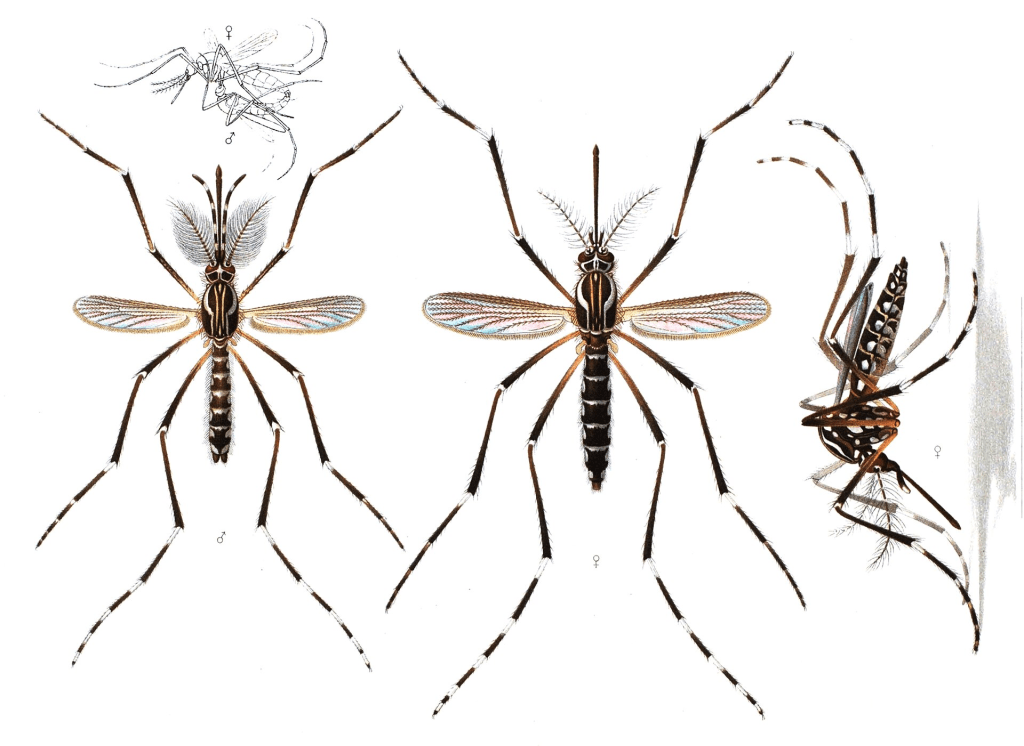
Mosquitoes are considered to be the most dangerous group of animals in the world. Among them, Aedes aegypti is one of the most dangerous (if not the most dangerous). This small mosquito is the main spreader of dengue, Zika, chikungunya, and yellow fever. Scientists consider it a highly competent vector, meaning it’s very good at picking up viruses, letting them grow inside its body, and passing them on to people.
But what makes Aedes aegypti such an efficient disease carrier?
It’s Built to Carry Viruses
When Aedes aegypti bites a person who has one of these viruses, the virus goes into the mosquito’s stomach (called the midgut). In some mosquito species, this is where the virus gets stopped. But in Aedes aegypti, the virus can easily enter the gut lining, multiply, and move to other parts of the body, including the salivary glands—where mosquito spit is made.
This means that the next time the mosquito bites someone, the virus is already in its saliva and can be injected directly into the person’s bloodstream and make the person sick (given that the person’s immune system fail to fight it off). The mosquito doesn’t get sick—it just helps the virus move around.
These internal barriers (the gut wall and the salivary glands) are not strong in Aedes aegypti, which is why viruses can move through the mosquito easily. This is because of the weak physical barriers and certain mechanisms carried out by the viruses to make the immune response of the mosquito weaker. The evolution with these viruses for a long time in tropical areas may have made these viruses well adapted to live and develop within Aedes aegypti mosquitos overcoming physical and chemical defense strategies.
It Has the Right Receptors for Viruses to Enter Its Cells
Viruses need a way to get into the mosquito’s cells. They do this by attaching to special proteins on the surface of the mosquito’s cells, kind of like using a key to open a lock. Aedes aegypti has the right kinds of proteins (receptors) in its gut and salivary glands that allow viruses like dengue, Zika, and chikungunya to easily enter and start multiplying. This may also be a result of co-evolving for a long time with viruses. Without these receptors, the viruses wouldn’t be able to infect the mosquito in the first place, which is the case in other mosquitos.
It Bites Humans Often and More Than Once
Aedes aegypti loves human blood. It usually lives in and around homes, and it prefers to bite humans rather than animals. It’s also active during the day, especially in the early morning and late afternoon, when people are outside. Also, a female Aedes aegypti often bites multiple people during a single egg-laying cycle (mosquitos feed on blood to get the nutrition needed for egg development). Because Aedes aegypti bites humans often and prefers them as hosts, viruses that infect humans get many chances to move between people through Aedes aegypti. This frequent exposure has driven viruses to evolve greater ability to infect and develop within Aedes aegypti, compared to other species of mosquitos*.* So the viruses have evolved to be better at infecting and developing inside this species, making it **probably the most dangerous species to humans.
Additional Reads
Novelo, M., Dutra, H.L., Metz, H.C., Jones, M.J., Sigle, L.T., Frentiu, F.D., Allen, S.L., Chenoweth, S.F. and McGraw, E.A., 2023. Dengue and chikungunya virus loads in the mosquito Aedes aegypti are determined by distinct genetic architectures. PLoS pathogens, 19(4), p.e1011307.
Powell, J.R., 2018. Mosquito-borne human viral diseases: why Aedes aegypti?. The American journal of tropical medicine and hygiene, 98(6), p.1563.
Bonizzoni, M., Dunn, W.A., Campbell, C.L., Olson, K.E., Marinotti, O. and James, A.A., 2012. Complex modulation of the Aedes aegypti transcriptome in response to dengue virus infection. PLoS one, 7(11), p.e50512.
 tharakawijerathna.com
Leave a comment